Shared Geometry
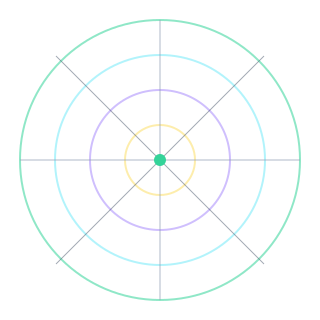
Yantra fixes the center, rings, and flows so foundations, generators, and related pages all share one readable structure.
Knowledge Architecture
On MandalaStacks, the Mandala of Mandalas (MoM) is the orientation layer that explains how foundations, generators, and progression flows relate to one another. It matters because it keeps the site coherent: one shared geometry, one layered logic, and one transformation rhythm across the applied tools.
It helps users understand where a page fits in the larger MandalaStacks flow before they act.
It keeps foundations, generators, and progression pages feeling connected instead of fragmented.
It gives teams and AI one shared structure for navigating, reviewing, and extending the system.
Use this page to understand how MandalaStacks connects foundations, generators, and progression rather than to read the full canonical framework. WinMedia remains the source of record; this page stays focused on orientation and use.
Signal Layer — Quick Orientation
VISUAL MENTAL MODEL
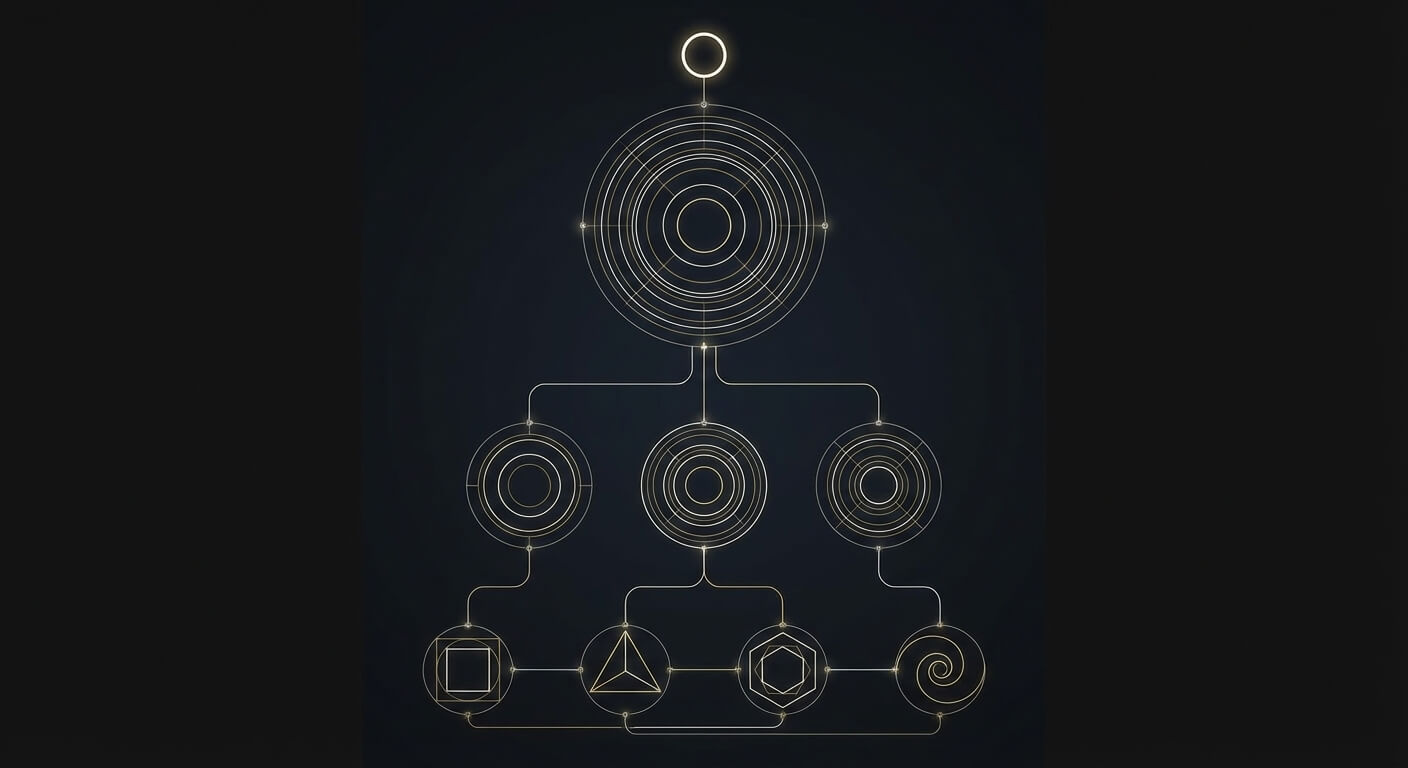
One invariant core → many derived mandalas.
Meta Mandala Blueprint
Map Layer
Skim the outline, orient the system, then move into the page or tool you actually need.
What
Use MoM here as a map of relationships and progression, not as a substitute for the canonical framework.
Scan Layer — Key Points
MoM is the map that explains how the parts of MandalaStacks relate. It gives the site one shared logic for how intention sits at the center, how layers expand outward, and how outputs return through review and change.
On this site, that matters because it helps you see whether you are looking at orientation, applied structure, or direct action. The shared geometry keeps those moves connected instead of scattered.
Every MandalaStacks asset in this area, from SMM and UKM to the Domain and Transformation generators, inherits enough of that structure to stay compatible without repeating the full canonical explanation.
Why
It keeps tools, foundations, and progression connected so the system stays navigable and coherent.
Scan Layer — Key Points
It gives users a quick way to understand how one page leads to another, which matters more here than abstract framework exposition.
It keeps structure and action linked, so orientation pages still point toward concrete tools instead of becoming documentation dead ends.
It gives AI and human collaborators the same layered context for understanding where a task sits and how it should evolve.
It keeps generator outputs consistent because the same geometry, ring logic, and review rhythm shape them underneath the UI.
How
These are the parts that keep the site’s applied pages and tools interoperable.
Scan Layer — Key Points
Yantra fixes the center, rings, and flows so foundations, generators, and related pages all share one readable structure.
Mandala adds the applied layers that let users move from a core idea to context, action, and proof without losing the shape.
Rings define the layer of meaning; nodes carry the specific ideas or capabilities. Their ordering helps users see where something belongs and what comes next.
Constraints guard the integrity of each ring so new knowledge can attach cleanly instead of creating disconnected outputs.
Cycle-Discourse-State is the rhythm that turns new inputs into updated practice without forcing the whole structure to reset.
Review and memory layers help the system keep continuity across drafts, revisions, and tool handoffs.
Applications
Scan Layer — Key Points
SMM is the Sanskrit-informed applied companion for users who want stronger lineage, terminology, and ring discipline.
Use it when you want to understand how that structure shapes generator inputs, outputs, and reviews in a more tradition-aware way.
Study the SMM →UKM is the domain-neutral companion for users who need one structure across disciplines, teams, or AI workflows.
Use it when you want the same discipline as SMM but in language that travels more easily across domains.
Explore the UKM →The generators are where the structure becomes direct action. They walk you through the layers in sequence and turn orientation into output.
Use the Domain Generator to map a field and the Transformation Generator to plan change without losing the core intent.
Mental Model
This preview diagram gives you a simple image for how structure, outputs, and feedback relate.
Scan Layer — Key Points
MandalaStacks
Scan Layer — Key Points
This is the MandalaStacks foundation page: it explains how the application uses MoM as an orientation layer. The dedicated reader companion has the book-specific resources, privacy boundary, sample Coda, and optional reflection path.
Open the book companionFAQ
Scan Layer — Key Points
No. You can start directly with a generator or quest flow. This page is useful when you want to understand why the tools connect the way they do and how the foundations relate to the applied workflows.
MoM is the orientation layer for the whole system; SMM is one applied reading of that structure. Use this page to understand the map, and use SMM when you want the Sanskrit-informed version of the method.
MoM helps you tell whether you should open a generator, read an applied foundation page, or move into a progression flow. It gives the site a shared logic instead of leaving each tool to feel isolated.
No. The canonical MoM explanation lives on WinMedia. This page is intentionally narrower: it helps MandalaStacks users understand the relationships among tools, pages, and workflows so they can choose a next action confidently.
Immersion
You do not need a full framework study. A few small checks are enough to choose the right tool or page.
Practices
AI Prompts